Friday, May 28, 2010

We've All Got Papers: The Role of Undocumented Students in the Classroom


You! You sitting with your computer reading my blog. Come closer. Closer. Closer still. I've got a secret for you. Are you ready? Here goes. I have taught undocumented students.

The response I get when I tell the aforementioned "secret" to people their reaction often varies with a wide range of emotion from disdain to praise. I assume that in this day and age, it's not necessarily a popular statement to make. However, it is the truth and I am never one to hide the truth from people, regardless of how uncomfortable it might make them. Working in inner city schools, you see and teach a variety of children throughout your time. Being three years into a hopefully long-lasting teaching career I already know that I have taught some undocumented students. And I know I will continue to teach them in the future. There are some students who confide in me with their deepest secret. There are others who I know I will end up teaching for an entire year and have no idea that they were even undocumented. Such is the nature of the beast.

One common argument on the immigration debate today is the fact that these undocumented students place an unfair burden on our education system. To this I have one simple response: Hogwash. The fact is that these students pose no more burden on our education system than affluent White kids from the suburbs. This "burden" that critics often speak of is set in place due to overcrowding in our inner city schools and the inadequate resources available to them. I have yet to hear a teacher say, "I was doing fine in my class with the first forty-one kids. However once I got that forty-second kid, that undocumented kid, that's when my classroom really went to hell." The fact is these students are part of the general school population and it is our job at teachers to teach all of our students no matter what kind of classroom conditions might be placed upon us.

I also hear the argument that these undocumented students are the troublemakers, the ones who are in gangs and wreak havoc upon their school communities. Again, this is a gross exaggeration of the truth. The fact is that yes, some undocumented students to end up choosing the gang route. However, this can be said for any immigration population that constantly faces the home-grown xenophobia that is so prevalent today. We as a society don't label all Asians as gang members just because a few Hmong students have chosen that route. Why should we do the same with Latinos? Of the (known) undocumented students I have taught, some of them were in gangs. Some of them were my hardest workers and best students. Undocumented students, like all students, run the gauntlet in terms of behavior. I feel no more "burdened" for teaching them as I do any of my other students.

There is also the criticism that these undocumented students do not even try to learn English. Again, another erroneous statement. Studies have shown that this current generation of immigrants are learning English faster than any generation that has proceeded them. I have yet to have a student flat out refuse to speak English. However, there are definitely some students that have been bullied by previous teachers and who definitely lack self-confidence in the language. Imagine if you went to a foreign country and were forced to speak a language you were still learning. Imagine that each time you misspoke, you were reprimanded. It would hurt your confidence, right? Make you hesitant to want to speak, to play with the language? This is the same experience that many of our undocumented students have had. Somewhere during their schooling, some teacher told them they were bad at speaking English. Odds are, it happened at an early age. This kind of experience can cause a child to shut down for a long period of time.

As teachers, we need to respect our students' home culture and language. Just because our students aren't producing constant English doesn't mean they aren't being exposed to it on a daily basis. Many of these students can code-switch back and forth between English and Spanish, which is an incredibly valuable asset. Having any student become fully bilingual will continue to help them throughout their lives in both school and their chosen professions. I personally have seen some of my undocumented students translate during parent conferences. They understand the need to maintain their cultural identity at home but also to do their best to learn the dominant language as well. For critics to say that these students don't learn English is a gross exaggeration and one that will not be verified in any public school today.

I guess my biggest qualm with all the criticism of undocumented students is how they are viewed as criminals. Many of these students were brought here at too young an age to have any choice in the matter. Some of them do not realize until their late high school years that they are even undocumented. Regardless of how you feel about the immigration debate, you must first realize that these students are HUMAN BEINGS. They know what is expected of them and they do their best to live up to teachers expectations. They laugh, cry, smile, and frown like all their peers. They play sports, have friends, go to dances, and date just like anybody else their age. The difference is that each and every day they come to school, there is the chance that their lives can be swept out from underneath them. They come, they take this chance each and every day, for a better life for both themselves and their family.

I leave you with this image: A student of mine in tears, being consoled by her boyfriend. This student not knowing whether or not this day would be her last in her school, her city, her country that she had known as far back as she could remember. This student who writes all her papers in Spanish and then meticulously translates them to English in my class of eighteen. This student who has been late to my class because she had to go with her younger brother on the city bus to go and try to track down his school ID. This student who missed classes one afternoon to be excused to attend a multi-cultural fair and dance with her partner. This student who writes about the greatness and fairness of the American laws but has to add that sometimes Immigration and Customs Enforcement (ICE) can be a little unfair. This right here is your undocumented student. The one who is a burden on me and my classes. The one who is a bad influence on her peers. The one who isn't trying to learn English. Contrary to popular belief, this student has papers. She has papers due in all of her academic classes. And knowing her, she will pass them all with flying colors.

Saturday, May 22, 2010

What Teachers Make

Slam poet Taylor Mali says it better than I ever could.

Saturday, May 8, 2010

Pick-A-Winner: The Objectivity of Multiple Choice Tests


In your journals, please answer the following question: What is a zigger?

A. A zogger
B. A zummer
C. A zooker
D. A zaller

The correct answer is B. For those of you who got it, congratulations. For those who didn't, well you obviously should have.

Pretty absurd, right? Well, not so much...

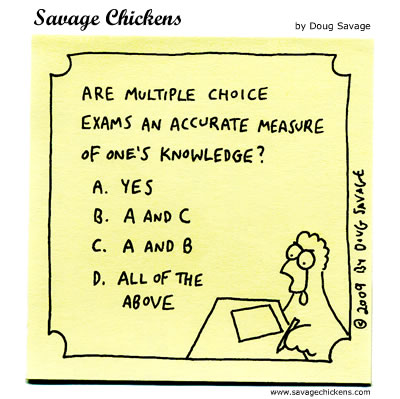
The above example is a variation of one given to me by my college adviser when he explained the evils of standardized testing, more specifically, that of multiple choice testing. This past week I had to watch students bubble in answers on state tests for four hours on two consecutive days. We have two more such days this upcoming week. Students are being asked to bubble in one of these four letters as a way to demonstrate how much they have learned throughout the year. If they are good bubblers then our school gets positive recognition. If they are bad bubblers, then it hurts our school. And yet, questions like the one in the cartoon and the one mentioned above are exactly what our students will see when dealing with the multiple choice subject tests given each year by the state of California and every other state across the nation.

Multiple choice tests are not a reflection of student knowledge. At all. They are a reflection of who is good at guessing. Think about it. The next time you or someone you know take a standardized test, try a little experiment if you have time. Go through a section, reading only the questions and not the answers. Put a mark next to all those you can answer without the multiple choice options. Odds are pretty slim, right? Maybe there's a question here and there that you could answer. But for the vast majority of the questions you will need to see the four possible answer choices. Therefore, you don't really know the answer. But you can be a good guesser and arrive at the right answer eventually. So did your history teacher this year spend all his time teaching you content or did he spend all his time teaching you how to guess? Odds are the guessing lessons were nowhere to be found.

And yet, this is exactly what multiple choice tests do to our students. Sure, there are test taking strategies such as eliminate ones you know it can't be, make educated guesses, etc. But when push comes to shove what multiple choice tests do is assess how good our students are at guessing. And let's be honest: These tests expect these kids to be pretty damn good guessers. None of the above, all of the above, B and C only. These tests expect them to be Nostradamus good at making predictions. We all know somebody super smart who bombed the SAT. We all know somebody non-so-smart who aced it. The difference? One was a poor guesser and the other was a great guesser. These great guessers end up going on to fame and fortune and those of us who can't guess as well lose out on many opportunities. Life really is a guessing game in this regard.

All this begs the question why. Why do we assess our students in this idiotic manner? Wouldn't it be much simpler to have students show off their knowledge in written or oral form? Instead of nitpicking certain elements, why not offer students multiple ways to demonstrate what they have learned? How amazing would it be to show the state of California how much we have learned this school year through the magic of art, song, dance, and performance? An actual painting for an art class. A video-taped reenactment for a famous historical event. A recording of a spoken word poem highlighting the various uses of voice in a poem. A written proof in geometry, using all the rules one had learned throughout the process. Yes, I can see it now. Cardboard boxes filled with student work being sent to Sacramento to be scored accurately by individuals who are experts in the various content areas. A true testament to student learning right there in the flesh.

And then I awaken from my idealistic slumber. Much like most things that make sense in public education today, this will not happen. The reason? Money. Cash. Cashola. The Almighty Dollar. The buck stops here. Literally. Yes, friends and family, we put the futures of students, school, and even entire school districts in the hands of our students' guessing abilities so that we can save money. That's it. That's your reason. We make our students bubble in letters so that we can ship up boxes to a secured location in Sacramento. Once there, student score sheets will be fed into computers that tell us how well students, schools, and districts guessed. The test booklets, where students took notes, showed work, and eliminated wrong answer choices? Discarded. Partial credit doesn't exist in the guessing world. These supercomputers tabulate the results and get them back to us within a few weeks. And we all know that these counting machines never ever make mistakes. Unless you're counting the 2000 presidential election...

So, in the coming week or so as you watch your students bubble in letters, think about your teaching. Was it really important that your students wrote personal narratives about themselves and their lives? Was it important that they created their very own webpages? That they made scrapbooks about life in the 1920's? That they read about current events and debated current immigration policy? That they made Styrofoam skulls and labeled all the parts of the brain? The answer to all these questions should be a resounding no. What you should have been teaching all along was the proper way to guess. Because after all according to state testing agencies, that is the only skill a student needs.

Saturday, April 17, 2010

Crippling American Education: (Un)blessed Union of Souls


"We're an organization. We here down south don't like to use the 'U' word..."

Thus began my first encounter into the world of organized labor in the education profession. From the very get-go, I had a chance to see a manipulative organization at its finest. The aforementioned speaker was the local union representative at the first school district I started in. He painted a picture of a magical bureaucratic machine that catered to a teacher's every need. Higher salary? You got it! Representation in the state capitol? You got it! The room of newcomers to the school district unfortunately bought it hook, link and sinker and immediately signed up to join this union (yes, I said union because that's what it is). The next day a gentleman from another union came and several of the people who had signed up for the other union had no idea that our district even had a second union. Thus, even those that joined were manipulated from the onset.

I never felt the need to join this union. The main reason is I didn't feel it was worth paying dues to an organization that did nothing for me. As my mentor teacher told me, as long as you keep your door open when you are working with a student, there is no need to join the union. (He felt the only quasi-benefit was the union's lawyer, but that he was needed only in extreme circumstances). The last year I worked for the district the union and all its members protested teacher salary cuts AFTER the cuts had already been made. The assistant principal, who shared my skepticism of the union, and I had a good larf about that one. All union members at my school wore red clothing one day to protest and then took a group photo in the cafeteria at the end of the school day. Despite this brilliant display of solidarity through color, the union members were unable to reacquire their lost salary.

This experience solidified my long, upstanding belief: Teacher's unions are an antiquated notion. I know, I know, I can hear the dissension now. "Without unions, we would be teaching in near prison conditions!" Um, hello? Thanks to the resegreation of America's schools, many inner city locations HAVE become like this. And these are teachers who ARE part of the union. Teachers are underpaid not because of their union or non-union status but rather because we as a nation have gone away from valuing the education profession. Inner city schools have become difficult environments not because of a lack of laws or conditions, but rather because the students there have been segregated and told repeatedly that they are no good.

The fact remains that unions serve no purpose in education today and have done more harm than good. The fact that teachers are one of the few professions that still have tenure boggles my mind. I am a good (not great) teacher. I WANT to be evaluated every year. If I'm not doing an adequate job then I deserve to be removed. If I can improve, I want to know how. This has caused teacher's today to become complacent. Students today learn differently than they did 5, 10, 20 years ago. We need new blood, a new infusion of teachers who grew up in similar fashion to our students. We need teachers who can relate to students on a personal level, who know how tempting it is to text in the middle of class, who get bored when a teacher lectures for an hour straight. Odds are that a complacent veteran teacher who has tenure does not want or care to change the way she or he teaches because in all honesty, why should they?

Unions also have thwarted any attempt to have student scores used as an assessment for teachers. Now, don't get me wrong I do not think these scores should be the sole measure of a teacher's effectiveness. But it should be a component. If I taught language arts for an entire year and my class didn't improve on the state test, then what was the purpose of me teaching for 180 days? We could have gotten a cardboard cutout of me and student scores would have been the same. If you are an effective teacher then your students' scores will improve. I'm not saying they will pass due to various socioeconomic reasons. Yet, at the very least they should improve and this should be a part of your year-end evaluation along with several other measures.

However, the major problem remains that teacher's unions are here to promote the status quo. That's why they are fighting tooth and nail in places like Washington, DC where Chancellor Rhee is removing inefficient principals and teachers. "How dare you make changes based on consistent failure!" the union cries. The problem is that Chancellor Rhee is going up against a powerful union. One whose hands are deep in the pockets of Washington lobbyists. This is a union that would lose a tremendous amount if the status quo was upturned. Think of how lucrative education is. Building contracts, food contracts, contracts with publishing companies, and the list goes on and on. Education is a business folks, plain and simple. Major unions like the NEA and the AFT have a lot to gain and lose should a city like Washington, DC succeed in its reform efforts.

So where does that leave us? Honestly, the answer is up a creek without a paddle. Very few people outside of education think negatively when they hear the term "union." This works in the NEA's and AFT's favor because of all the benefits that various unions have provided our country over its history. To be anti-union is to be un-American! We've all heard that, and the teacher's unions take this mentality and run with it. For those of us that choose not to join unions, the problem is we are so small in number it is hard to overcome. The unions also have corporate backing and powerful lobbyists in DC. What they want is what is best for business and this in no way correlates as to what is best for children's education. Teachers unions are not part of the solution to fix education as they claim. The harsh reality is that they are and will continue to be a major part of the problem.

Wednesday, March 31, 2010

Two's Company: A Response to Critics of Bilingual Education


I feel compelled today to discuss the idea of bilingual education. This is something I am a passionate believer in yet it is something that continues to be underfunded and misunderstood at the national level. It is something that brings forth heated debate on both sides and yet ultimately no compromise is reached. It seems like this is an issue with no middle ground. You are either for or against bilingual education in schools and there are no ifs, ands, or butts about it. It remains one of the super sensitive issues that Americans love to debate, right up there with abortion rights, health care, and gay marriage.

I could defend my position by citing study after study about bilingual research and its positive effects. However, I think it is most important to tell why I favor bilingual education with my own story. There is a simply truth: I am a better person because of my bilingual education experience. Starting in middle school when I first began taking Spanish language courses, I was opened up to a new culture. Growing up in suburban New Hampshire where my town’s population was 97% Caucasian, I did not have access to a lot of diversity. I firmly believe that I am where I am today because my bilingual education experience in schools opened up doors that I wouldn’t have otherwise known had existed.

The best thing about studying a second language is experiencing the culture that goes with it. Throughout middle and high school I ate Hispanic food, did Hispanic dances, and watched Hispanic television. I was able to read the great poetry of Federico Garcia Lorca and Antonio Machado. I got to study the amazing art of Velazquez, El Greco, Picasso, and Salvador Dali. I got to see movies dealing with the difficulties of trying to immigrate to the United States. I also had an opportunity to learn about a Los Angeles high school calculus teacher who inspired his students in the movie Stand and Deliver. Recently the math teacher, Jaime Escalante, who the film portrayed passed away. However a good friend and I recently reflected about how fortunate we were learn Escalante’s story in our senior Spanish class. The culmination of my high school Spanish experience was spending a week in Spain during my senior year and seeing just how far I’d come with the language.

In college, I continued taking Spanish courses my first two years. I read more Spanish literature and took my first conversation class. As part of that class, we had a chance to work at a center where Spanish-speaking adults were learning English. Our professor introduced us to the music of Bacilos and Juanes, two artists that now feature heavily on my Spanish playlist. We had opportunities to role play and had to create our own dialogues for classroom skits. The professor definitely challenged us to get outside our comfort zone, but in the end I felt it was a much more enriching language experience because of everything I had been exposed to.

Then, my junior year came around and I was fortunate enough to travel to Spain for the fall semester. I did my best to embrace the culture and every morning I marveled at the fact that I was walking to Europe’s third oldest university to take classes. I learned about Spanish art and architecture and got to travel all around the country. I did the touristy things such as seeing the famous statues, churches, and buildings. However, the most intimate moments I had were in the streets or in the parks talking to Spaniards about their lives and their beliefs. My parents came to visit me and we spent a weekend in Portugal together. Upon their departure my dad told me that he could tell this had been a rewarding experience for me in the fact that I was so much more confident now as a person than I was when I started.

That is my bilingual educational experience in a nutshell. I am a better person because I had all these experiences. When I first began teaching, I wanted to work with a diverse student population. I currently work at a school with a large amount of diversity and I think I learn as much, maybe more, than the kids do on a daily basis. I also greatly enjoy the interactions in the grad school program. Learning about the culture and lifestyles of Saudi Arabia, China, Taiwan, and Kuwait make me a better teacher and a person. Even though I teach history and consider myself to be fairly world savvy, I still learn new things each and every day from my classmates. Their experiences help shape who I am and how I view the world.

I realize that not everybody has had a similar bilingual experience. I also realize that I come from a privileged background and thus had opportunities that many others could not have. I was always in the advanced Spanish classes in high school. My parents could afford to send me to Spain my senior year and also afford to send me to a good university where studying abroad was an option. I had financial stability that allowed me to travel all around Europe when I was there. I currently have the funds available to continue to teach but also pursue my master’s degree in education. I am well aware that many of these opportunities have been given to me because of how I look and how much money my parents make.

However, if bilingual education has so much to offer just one small-town boy from New Hampshire, shouldn’t we at least try to offer these kind of experiences to those across our great land? The answer clearly should be yes; however, it will ultimately be met with much resistance. In today’s educational setting where funds for education are dissipating, can we really afford to add bilingual educational programs? And do our students really need to speak another language? Let’s be honest, English is the lingua franca. You can go to pretty much anywhere in the world and find someone who speaks English. If it’s something that is not even needed to be competitive at the global level, should it really be stressed at this point in time in our schools?

The answer in my opinion is a resounding yes. We need to somehow, some way figure out how to implement bilingual programs into our schools. At a time and place where the world is becoming more interconnected each and every day, it is becoming a necessity to speak a second language. The majority of students I traveled abroad with were pre-med. They knew that in order to get the best jobs at the best hospitals they would need that additional feather in their cap. Finding a teaching job in California in 2010 is difficult enough. I can’t imagine trying to go at it and not be bilingual. I have heard firsthand stories of teachers whose jobs were saved due to their bilingual abilities.

Lastly, I will leave with this point: Don’t we as a country want to better ourselves? We can become better people by studying and learning about other cultures. We can be better informed about world events and understand how and why certain events are unfolding the way they are. It’s time for Americans to realize that English can only get you so far in this day and age. We as a society need to embrace the interconnectedness of the world today and use it as a vehicle to better ourselves. We have the ability to learn so much about ourselves and our neighbors and all we have to talk is learn their language. I can’t speak for everyone, but it seems like a worthwhile investment to me.

Tuesday, March 30, 2010

RIP Jaime Escalante (December 31, 1930 - March 30, 2010)

The man who inspired the 1988 film Stand and Deliver passed away earlier tonight at the age of 79. Thank you for giving me ganas, Mr. Escalante. The education world will miss you.

Saturday, February 27, 2010

Fall Into the (Achievement) Gap: A Uniform Decision


Recently, thanks to the keen eye of my mentor and good friend Ray Jones, an article has come to my attention that deserves to be discussed. The article itself is from the Winston-Salem Journal and describes how my former middle school intends to implement school uniforms starting next fall (http://www2.journalnow.com/content/2010/feb/15/philo-gets-dress-code/). This in itself is not much of a surprise. This was something that had been discussed while I taught at Philo and was something the administration and staff had supported. However, I felt compelled to comment on this topic not so much because of what the article said, but because of the abundance of comments that the article generated. Let's take a look at some of these from the Winston-Salem Journal website:

"It sure was nice long ago when us kids could wear whatever we wanted and no one was around to ruin it for the rest of us. Why don't they discipline or remove the offenders?"

"We must provider these kids meals because they and their parents decide to spend money on expensive clothing and not food. Many of these people are not poor. They are just lazy, greedy and vain. Such people are an insult to the true poor."

"Parents are also negligent for allowing their children to wear unacceptable clothing. Most problems start in the home."

"I wonder how many of those who qualified for the discounted meals [free and reduced lunch] own 1 or more cell phones? 1 or more vehicles? 1 or more color televisions? A sophisticated video game system?"

"The ACLU needs to challenge this. No way a public school can demand that a child must dress a certain way. A school can certainly BAN an item of clothing but it has no right dictating what a child has to wear in order to attend public school."

After my head stopped spinning from reading these comments, I felt I had to express my own opinion seeing as I actually had set foot inside Philo's hallways unlike any of the above posters. First and foremost, I feel this is a positive decision for the school. Truth be told, we tried to implement a quasi dress code my first year at the school for the 07-08 school year. We required students to tuck in their shirts and wear belts to keep their pants from sagging. The students at Philo fought, and fought hard. We tried to suspend our repeat offenders, but it got to the point that students flat out refused to do what was being asked of them. I saw students disrespect not only teachers but administrators as well by refusing to adhere to the dress code. About 2/3 of the way through that year, we as a staff decided to cut our losses, and we vowed to implement a school-wide dress code the following year.

Unfortunately, with the change over from one administration to a new one, the idea of a dress code got lost in the shuffle. It was not until about two months into my second year that the idea was breached again, and by that time it was too late to implement anything for the 08-09 school year. However, there was without question a need for the dress code. Students wore sagging pants, inappropriate shirts, as well as gang affiliated clothing. It got to the point where I could tell you which young men would be coming to school on a Wednesday wearing white t-shirts and jeans. That was no accident, those were gang members showing off their "true colors." When a group of 15 boys walk down the hall together wearing the same thing, you know something is up. Any time students can openly broadcast their gang affiliation, it is time for a needed change.

That is why the offenders were not removed as one of the comments suggested. In terms of the ACLU getting involved, well I wouldn't lose any sleep over that one. Besides since 80% of the parents and staff approved the new dress codes, they have no legal recourse anyway. One comment I didn't post mentioned how students would now want to leave the school if they had to wear a uniform. This poster clearly has no idea about Philo's demographics. Half of our students are Hispanic. Many of their parents or even themselves come from a background of wearing school uniforms. This is nothing new and I wouldn't be surprised if many of the families actually embraced this new dress code. There will inevitably be a handful of students who leave. That is their choice and ultimately, if you don't buy into a school's philosophy then maybe you should consider other options anyway.

I also wanted to comment on the posts about welfare and the socio-economics of the lower class. These posters clearly have no idea about what is going on. The truth is that there is a class system even within the urban poor. One way to assert your status in this group is by what you own. Conspicuous consumption is not a trait reserved for the elite. Students from lower socio-economic families know they too are being judged on a day-to-day basis. Yes, they are on free and reduced lunch. However, this doesn't stop them from owning an iPod or having new sneakers. I have seen near fights break out over some boy scuffing another's shoes. Walk into any middle school boy's bathroom and you will see the boys fixing two things: their hair and their shoes. If you ever want to get on a young male's good side, complement his shoes and he will immediately respect you.

Lastly, the comment about letting their child leave the home dressed the way they are was simply foolish. These are single parent homes for the most part. Some students live with a relative, others live in foster homes. The whole idea of "dressing properly" is a middle-class value that we assume our students to have when they get to us. The truth is, they don't know what it means to dress "properly" and neither do the parents. I have met parents who dress the same way as their children. Some dads come in to parent conferences with baseball caps, baggy jeans, and do-rags. Some moms come in to parent conferences with t-shirts that are 1-2 sizes too small. It is the culture and we should not be judging them for their mode of dress. Students either emulate their parents or their peers in terms of dress. Also, a lot of their parents work multiple jobs and multiple shifts so many of them are forced to fend for themselves in the morning. They wear want they want to and so do their younger siblings that they might be in charge of. For students of poverty, how they look in the mirror when they leave the house is the least of their concerns.

I applaud Philo for this decision. The truth is that once clothing threatens the safety of a school, it is time for a change. That is how I felt about the dress code when I was there. I have nothing against gang members. I have taught them before and I teach them now. Some of them have been very pleasant young men and women in the classroom. However, what they do outside of school needs to stay outside of school. The more visible they are, the more likely it becomes that younger children will want to emulate them. I saw gang membership increase twofold from my first year to my second year at Philo. That is because of the presence of gang members and their gang-affiliated clothing. People knew who the gang members were. I had one African American student find a Hispanic gang member's bandanna with the gang colors. He dragged it on the floor and then took it into the restroom where he urinated on it and flushed it down the toilet. He knew what that bandanna stood for and so did I. With uniforms, that tension that the African American student displayed will be greatly decreased. Then and only then will the teachers at Philo be able to teach in an environment that is truly conducive to learning.